
Posted by Gigi J.K
in Ai
in Ai
From Funnel to Pinball: Why Diagnosing Your Funnel Shape Is the Missing Step in Modern Marketing Strategy
 Written by
Gigi J.K
Written by
Gigi J.K

Most marketing frameworks do a good job explaining how buyers behave. None of them tell you what to do about it. That gap—between behavioral insight and strategic execution—is exactly where marketing systems break down.
If you’ve ever built a beautifully structured marketing funnel only to find that your buyers don’t follow it, you’re not alone. The reality is that your funnel’s shape isn’t something you get to choose—it’s something your customers already determine. Your job is to diagnose it.
This article walks through the full evolution of buyer journey frameworks, explains why each falls short, and introduces a structured approach to funnel shape diagnosis that bridges the gap between theory and execution.
A marketing funnel is a model that represents how customers move from first awareness of a product or service to the point of purchase. Traditionally, this follows a straightforward linear path:
This structure assumes buyers move step-by-step toward a decision, in a controlled, predictable order. And for a certain era of marketing—direct mail, broadcast advertising, catalog selling—it worked reasonably well.
The problem is that buyers today don’t behave this way. They never really did, but the gap between model and reality has grown exponentially with the rise of digital channels, independent research behavior, and social proof dynamics.

The classic funnel assumes three conditions that modern markets routinely violate:
Modern buyer behavior contradicts all three. Today’s buyers:
This behavioral shift has generated a proliferation of alternative frameworks, each trying to better represent the complexity of modern purchase decisions. But most of them stop at description. They explain the problem without solving it.
Understanding where the major frameworks succeed—and where they fall short—is essential context for why funnel shape diagnosis matters.
The AIDA model (Awareness, Interest, Desire, Action) dates back to the late 19th century and was refined throughout the 20th century into the marketing funnel most practitioners still recognize. Its strength is simplicity: it’s easy to understand, easy to teach, and easy to build KPIs around. Its fatal limitation is that it doesn’t reflect real buyer behavior in complex or digital-first environments. It remains useful as a starting vocabulary, but it’s not a complete strategic model.
Google’s research team identified that buyers cycle between two mental modes: exploration (broadening their options) and evaluation (narrowing them down). Rather than a clean funnel, buyers loop back and forth between these states indefinitely until something triggers a purchase decision. The model effectively captures the cognitive reality of modern purchasing—including how behavioral biases like social proof, authority, and scarcity influence decisions. Its limitation is that it describes behavior without providing a system for strategy design. You understand the problem, but you still don’t know what to build.
McKinsey introduced a circular model that expands the traditional funnel to include loyalty and re-entry. After purchase, buyers either enter a loyalty loop (repurchasing without re-evaluating) or return to active evaluation. This framework is particularly valuable for thinking about retention and post-purchase experience, but it’s high-level and conceptual—not designed for tactical execution or campaign architecture.
Gartner’s framework reframes the B2B buying process as a series of “jobs to be done”—tasks that buying teams must complete before committing to a purchase. These jobs include: problem identification, solution exploration, requirements building, supplier selection, validation, and consensus creation. What makes this framework especially powerful is its recognition that multiple stakeholders with competing priorities must reach alignment. Its weakness is structural: it’s not designed as a funnel and doesn’t translate directly into a marketing system for top-of-funnel through conversion.
HubSpot’s flywheel model reframes marketing, sales, and service as a continuous growth loop—where delighted customers become the fuel for new acquisition through referrals and advocacy. The flywheel correctly shifts attention from one-time conversion to ongoing relationship value. Its limitation is that it’s more of an operational model than a buyer behavior model. It describes how your business should run, not how your customers actually make decisions.
SparkToro’s Rand Fishkin introduced the pinball funnel to describe the reality of fragmented, multi-channel discovery. In a pinball funnel, buyers bounce unpredictably across touchpoints—a podcast mention, a LinkedIn post, a search result, a colleague recommendation, a retargeted ad—before eventually converting. Attribution becomes nearly impossible. The model is a vivid and accurate description of the chaos. But like the others, it doesn’t provide a classification system or strategic framework. It explains what you’re dealing with, not what to do about it.
Framework | Structure | What It Explains | Key Gap |
|---|---|---|---|
Traditional Funnel | Linear | Conversion stages | Unrealistic behavior assumption |
Google Messy Middle | Loop | Decision process | No execution model |
McKinsey CDJ | Circular | Lifecycle & loyalty | Too abstract for tactics |
Gartner B2B Journey | Task-based | Enterprise buying complexity | No funnel structure |
HubSpot Flywheel | Continuous loop | Growth & retention | Not buyer-journey focused |
Pinball Funnel | Networked/chaotic | Channel fragmentation | No strategy linkage |
The core gap: Every major framework answers how buyers behave. None answer how your strategy should adapt to that behavior. This is where most marketing systems break down.
Before designing strategy, you must first answer a foundational question:
What is the actual shape of the buyer journey for this Ideal Customer Profile (ICP)?
Not the funnel you want. Not the funnel that looks cleanest in a slide deck. The funnel your buyers actually follow.
This is the missing step in modern marketing strategy. Instead of choosing a funnel model upfront based on industry convention or internal preference, you diagnose it based on buyer behavior evidence.
This introduces a spectrum of funnel shapes, ranging from highly ordered to highly chaotic:
Classic Linear → Layered → Loop → Hybrid Adaptive → Pinball
Where your business sits on that spectrum—for a specific ICP, in a specific market context—determines everything else: your channel priorities, your content architecture, your conversion design, and your measurement approach.
Common in: transactional B2C, commodity purchasing, repeat orders with established vendors
Common in: mid-market B2B, solution-aware buyers, considered purchases with 1–2 stakeholders
Common in: software selection, professional services, regulated industries, complex product evaluations
Common in: high-awareness consumer categories, social-commerce, community-driven B2B niches
Common in: B2B services, management consulting, enterprise SaaS, digital transformation engagements
The Hybrid Adaptive Funnel deserves particular attention because it represents the reality for most serious B2B companies. The decision process has structure—there are definable stages—but the journey to each stage is messy and non-linear. Buyers might discover you through a LinkedIn post, validate through a Google search, read a case study three weeks later, then attend a webinar before finally booking a call. Each touchpoint contributes; none alone closes.
Each of the major frameworks captures part of the truth:
But they operate independently, without a shared language or classification system. And critically, none of them:
The practical consequence is that teams using these frameworks end up with a rich description of the problem but no executable answer. A strategist who reads about the Messy Middle understands that buyers loop between exploration and evaluation—but still has to decide: what content do I create, on what channels, with what conversion architecture, measured against what KPIs?
That’s the gap. And it’s significant.
ImpelHub builds on the foundational insights of these frameworks but adds the layer that has been missing: a structured process that moves from behavioral observation to strategic prescription.
The methodology operates in three phases:
Using six key dimensions, ImpelHub maps the actual buyer journey for a specific ICP:
The combination of these six dimensions determines where a business’s buyer journey sits on the funnel spectrum—Linear, Layered, Loop, Pinball, or Hybrid Adaptive. This isn’t a subjective categorization; it’s derived from observable behavioral patterns in your actual customer data, sales conversations, and market research.
Each funnel shape produces a different strategic prescription:
| Funnel Shape | Channel Priority | Content Strategy | Conversion Design |
|---|---|---|---|
| Linear | Paid search, direct | High-intent landing pages | Frictionless, fast |
| Layered | SEO + retargeting | Comparison content, case studies | Lead nurture sequences |
| Loop | Content + email + demos | Education-heavy, objection handling | Multi-touch nurture |
| Pinball | Omnipresence across channels | Brand-consistent, diverse formats | Easy re-entry points |
| Hybrid Adaptive | Broad top, structured mid/bottom | Stage-specific assets per stakeholder | Milestone-based conversion |
This is where the methodology creates real strategic advantage. Instead of applying a generic playbook, you’re executing a strategy that’s calibrated to how your specific buyers actually make decisions.
Feature | Traditional Funnel | Pinball Funnel |
|---|---|---|
Structure | Linear, sequential | Non-linear, networked |
Entry Points | Few, controlled | Many, unpredictable |
Marketer Control | High | Low |
Number of Touchpoints | Limited | Extensive |
Attribution Clarity | Clear | Fragmented |
Content Requirements | Stage-specific | Omnidirectional |
Best KPIs | Stage conversion rates | Brand awareness, share of voice, assisted conversions |
Strategy Approach | Sequential campaign design | Presence and trust building across all channels |
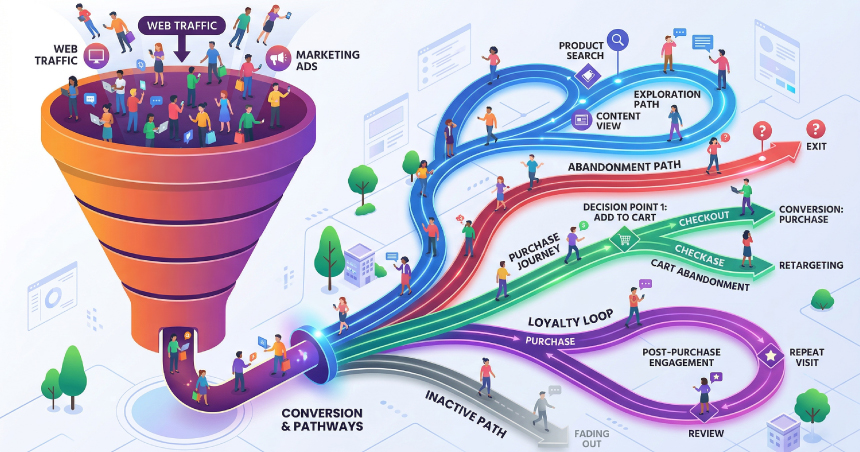
Marketing strategy is undergoing a fundamental reorientation. For decades, the discipline was organized around funnel design—you built the funnel, and then you tried to push buyers through it. The implicit assumption was that your funnel was the right one, and the buyer just needed to comply.
The emerging paradigm flips that logic. The buyer’s journey is a given—a reflection of real human decision-making behavior in a complex information environment. Your job isn’t to impose a funnel on buyers; it’s to understand the shape of their existing journey and design your marketing system to match it.
This shift has real implications:
The wrong question: “What funnel should we use?”The right question: “What funnel shape do our customers already follow—and how do we build around it?”
Diagnosing your funnel shape starts with honest observation of your existing customer data and sales conversations. Here’s a working framework to begin:
The combination of these six factors determines where your business sits on the funnel spectrum. Most B2B service businesses and consultancies will find themselves firmly in Hybrid Adaptive territory—which means they need both structured nurture sequences and broad-presence brand strategies running simultaneously.
The marketing landscape has changed dramatically, but most marketing systems haven’t caught up. Teams are still designing linear funnels for buyers who behave like pinballs. They’re measuring last-click conversions in multi-touch journeys. They’re building content for a single buyer when six stakeholders are involved in the decision.
The frameworks that exist—Messy Middle, Pinball Funnel, McKinsey CDJ, Gartner’s B2B model—have done important work in describing the real complexity of buyer behavior. But description isn’t strategy. Insight without execution is just interesting.
The missing step is diagnosis: identifying the actual shape of your buyer’s journey, classifying it systematically, and using that classification to drive every strategic decision that follows.
When your funnel shape matches your buyer’s reality, everything gets easier. Channels start converting. Content starts resonating. Pipeline starts moving. Not because you got lucky—but because you built a system that fits the way your customers actually buy.
Most frameworks explain how buyers behave. Few help you decide what to do next. The advantage comes from connecting behavioral insight directly to strategic execution—and that starts with diagnosing your funnel shape.
A funnel shape describes how customers move through discovery, evaluation, and conversion—ranging from linear, predictable progressions to highly fragmented, non-linear journeys. The five main funnel shapes are: Linear, Layered, Loop, Pinball, and Hybrid Adaptive. Identifying your funnel shape is the first step in designing a strategy that aligns with real buyer behavior.
A traditional funnel is linear, with few entry points, high marketer control, and clear attribution. A pinball funnel is non-linear, with many entry points, fragmented touchpoints, and low attribution clarity. The traditional funnel reflects how marketers wish buyers behaved; the pinball funnel reflects how many of them actually behave in a multi-channel digital environment.
Frameworks like Google’s Messy Middle and Rand Fishkin’s Pinball Funnel are descriptive—they explain what buyer behavior looks like. ImpelHub adds a classification system and strategic translation layer. It diagnoses your specific funnel shape, classifies it across a five-type spectrum, and connects that shape directly to channel selection, content strategy, conversion design, and KPI frameworks. It turns behavioral insight into an actionable decision system.
Without funnel shape diagnosis, marketing strategy is built on assumptions that may be completely wrong for your actual buyers. A strategy designed for a linear funnel will underperform in a loop or hybrid funnel—and vice versa. Funnel shape diagnosis ensures your channel mix, content investments, and conversion architecture are aligned with how your ideal customers actually make buying decisions.
The five funnel shapes are: (1) Linear—short decision cycles, few entry points, minimal research; (2) Layered—structured stages with moderate validation; (3) Loop—repeated evaluation cycles with heavy education requirements; (4) Pinball—fragmented, multi-channel discovery with low attribution clarity; (5) Hybrid Adaptive—structured decision stages combined with non-linear discovery, most common in B2B services and consulting.
The Hybrid Adaptive Funnel is a funnel shape that combines structured decision stages with non-linear discovery and evaluation processes. It’s most common in B2B services, consulting, and enterprise sales—where the buying process has identifiable milestones (like a scoping call or proposal) but the path to those milestones is chaotic and multi-channel. Effective strategy for this funnel type requires both structured nurture sequences and broad-presence brand building.
2 combos (1 competitor × 2 dimensions)
20 combos $5 per additional combo
100 combos $4 per additional combo
280 combos $3 per additional combo

7 Steps / 8 – 10 days / 2 – 3 hours of your time
Maximize your impact with ImpelHub’s Growth Lever Identifier—our AI-powered system that discovers your single biggest growth lever and accelerates your success. By analyzing your revenue streams, marketing channels, and core metrics, it highlights the most effective path to scalable growth and pinpoints your highest-ROI strategy, so you can focus on what truly matters, multiply your revenue, and stay ahead in today’s competitive market. Our clear, data-driven action plan ensures you can scale faster and more efficiently than ever.
Insight360, part of the “Your Business” pillar in the Business Brain/Context framework, delivers data-driven insights across 9 categories and 40+ business aspects, including market positioning, competition, revenue, trends, and brand identity.
It drives two key outputs:
With a multidimensional business view, Insight360 helps optimize positioning, enhance engagement, and accelerate growth.
Insight360+ expands on Insight360 with 15 additional dimensions, offering a deeper analysis of business strategy. It provides a self-reflective framework to uncover opportunities in:
With Insight360+, businesses refine strategies, strengthen positioning, and drive sustainable growth.
FanScope is a comprehensive catalog of buyer types, categorized by 10 key attributes, helping decision-makers assess and refine target audiences before segmentation.
As the first step in segmentation, FanScope informs:
By analyzing buyer roles, revenue segments, and purchase probabilities, FanScope enhances targeting, optimizes resources, and improves sales and marketing efficiency.
The Segmentation Module enhances customer targeting with Rated ICPs, Personas, and Firmographics (B2B), assessing each ICP across 22 attributes, including:
ICP Scoring evaluates profiles on 10 numerical dimensions, enabling businesses to prioritize high-value targets efficiently.
FoeScope is a competitive analysis framework that evaluates competitors across three revenue segments—small, medium, and large—relative to the business’s revenue. It assesses:
As a precursor to CounterEdge, FoeScope helps businesses identify and categorize key competitors, setting the stage for deeper competitive strategy development.
CounterEdge analyzes competitor growth strategies, their impact on the business, and countermeasures to stay competitive. It evaluates:
By leveraging CounterEdge, businesses can anticipate threats, mitigate risks, and implement winning strategies.
NextMove is a growth strategy framework that helps businesses identify, evaluate, and implement high-impact strategies. Each strategy is numerically rated across 10 dimensions, similar to ICP Rating, to prioritize the most effective paths for expansion.
With NextMove, businesses gain a data-driven approach to strategic growth, ensuring scalability, market expansion, and long-term success.
Launch-Execution Blueprint creates high-level execution plans for growth strategies, prioritizing them based on impact, feasibility, and business alignment.
By leveraging Launch-Execution Blueprint, businesses can streamline execution, focus on high-impact strategies, and drive measurable growth.
Maximize your impact with ImpelHub’s AI-powered Growth Lever Identifier. By analyzing revenue streams, marketing channels, and core metrics, it uncovers your biggest growth lever and highest-ROI strategy.
With a clear, data-driven action plan, you can focus on what matters, scale faster, and stay ahead in today’s competitive market.
Maximize your impact with ImpelHub’s Growth Lever Identifier—our AI-powered system that discovers your single biggest growth lever and accelerates your success. By analyzing your revenue streams, marketing channels, and core metrics, it highlights the most effective path to scalable growth and pinpoints your highest-ROI strategy, so you can focus on what truly matters, multiply your revenue, and stay ahead in today’s competitive market. Our clear, data-driven action plan ensures you can scale faster and more efficiently than ever.
Feature Gap Analysis is a powerful tool within ImpelHub that identifies missing or desired features based on the needs and expectations of the target audience. By leveraging Business Brain, it ensures that feature recommendations are strategically aligned with business goals and market demand.
Key Benefits:
Identifies Missing Features – Pinpoints gaps in the product or service offering.
Aligns with Target Audience Needs – Ensures features meet user expectations.
Prioritization via Impact Scoring – Helps decision-makers invest wisely.
Data-Driven Scoring Mechanism
Each feature is rated across five numerical dimensions, enabling businesses to prioritize development efforts effectively:
Revenue Boost
Cost Reduction
Customer Acquisition
Customer Retention
Customer Satisfaction
By leveraging Feature Gap Analysis, businesses can make informed investment decisions, enhance their product-market fit, and drive customer engagement and growth
UXI (User Experience Investigation) is a UI/UX audit framework that evaluates core business pages with unparalleled depth, powered by ImpelHub Audit. Unlike standard audits, ImpelHub leverages Business Brain, ensuring that recommendations are contextually aligned with the company’s strategy, market position, and growth objectives.
Key Audit Components:
Feature & Objective – Identifies key UI/UX elements and their purpose.
Details & Justification – Explains audit findings in a business-relevant manner.
Impact & Area – Evaluates influence on user experience.
Rationale – Context-driven reasoning for suggested improvements.
Impact-Driven Scoring Mechanism
Each UI/UX strategy is numerically rated across five dimensions, helping decision-makers prioritize investments:
Revenue Boost
Cost Reduction
Customer Acquisition
Customer Retention
Customer Satisfaction
This data-driven scoring allows businesses to allocate resources effectively, ensuring maximum ROI on UI/UX improvements and driving sustained growth
Detailed Execution Blueprint is a task list and project roadmap that breaks down high-level strategies into step-by-step, week-by-week execution plans, ready for team assignment and implementation.
Key Features:
Detailed Task Breakdown – Converts strategies into actionable steps.
Week-by-Week Execution Timeline – Ensures structured and phased implementation.
Team Assignments – Each plan is ready to be assigned to the relevant team for execution.
Operational Clarity & Accountability – Provides a clear roadmap to track progress.
By leveraging Launch-Detailed Plan, businesses can ensure smooth execution, improve efficiency, and drive successful implementation
FanScope is an extensive catalog of potential buyer types, both direct and indirect, categorized using 10 key attributes. It helps decision-makers identify, evaluate, and include or exclude buyer types before the segmentation process.
As the first step toward segmentation, FanScope informs:
ICP (Ideal Customer Profile) Definitions
Persona Development
Firmographics (B2B segmentation)
ICP Scoring
By analyzing buyer roles, revenue segments, pain points, and purchase probabilities, FanScope enables businesses to refine their target audience, optimize resource allocation, and improve sales and marketing efficiency.
The Segmentation Module refines customer targeting through Rated ICPs, Personas, and Firmographics (B2B). Each ICP is assessed across 22 attributes, covering:
Profile & Behavior – Segment, characteristics, decision-makers, and buying behavior.
Business Fit – Pain points, goals, product needs, and purchase drivers.
Engagement Factors – Technology, content consumption, marketing channels, and objections.
Strategic Insights – Value proposition, competition, and customer service needs.
ICP Scoring rates each profile on 10 numerical dimensions, helping decision-makers quickly prioritize the best targets for sales and marketing strategies
FoeScope is a competitive analysis framework that identifies and evaluates competitors across three revenue segments—small, medium, and large—relative to the business’s revenue. It assesses competitors based on:
Key Products/Services – Most similar offerings.
Geography – Market overlap.
Target Audience – Shared customer base.
Similarity Score & Reasoning – Measures alignment with the business.
FoeScope serves as a precursor to CounterEdge, laying the groundwork for deeper competitive strategy development by helping businesses identify and categorize their most relevant competitors
CounterEdge analyzes competitor growth strategies, their impact on the client’s business, and countermeasures to stay competitive. It evaluates:
Competitor Strength & Market Impact – Key advantages and threat level.
Affected Business Touchpoints – Areas influenced by competition.
Adaptation Strategy – Actionable countermeasures.
Impact Grade & Rationale – Severity of threat (1-5).
Potential Business Benefits – Strategic opportunities.
By leveraging CounterEdge, businesses can anticipate threats, mitigate risks, and implement winning strategies.
NextMove is a growth strategy framework designed to help businesses identify, evaluate, and implement high-impact strategies. Each strategy is numerically rated across 10 dimensions, similar to ICP Rating, allowing decision-makers to prioritize the most effective paths for expansion.
Key Assessment Areas:
Strategy Type, Objective & Target Audience – Defines the approach, aligns with Ideal Customer Profiles (ICPs), and ensures relevance to market needs.
Key Tactics & Content Marketing – Outlines the execution plan, including marketing initiatives to drive engagement.
Required Resources & Risk Assessment – Identifies necessary investments, potential risks, and feasibility.
Timeline & Measurement Metrics – Provides a structured roadmap for execution and tracking success.
Relevance (%) & Potential Impact – Scores strategies based on alignment with business goals, market trends, and competitive landscape.
By leveraging NextMove, businesses gain a data-driven approach to strategic growth, enabling them to quickly assess and implement the most effective strategies for scalability, market expansion, and long-term success.
GTM/Scale Up Playbook creates high-level execution plans for selected growth strategies, ensuring effective implementation. It prioritizes strategies based on impact, feasibility, and alignment with business objectives.
Key Components:
Phases – Defines the execution stage.
Strategy Score – Numerical rating for prioritization.
Strategy Suggestions & Rationale – Recommended actions with justification.
Highlights – Key takeaways and strategic advantages.
Related Strategy – Links to complementary approaches.
Targeted ICPs (ICP Phase) – Aligns execution with the right customer segments.
By leveraging GTM/Scale Up Playbook, businesses can streamline execution, focus on high-impact strategies, and drive measurable growth.
Insight360 is a key component of the “Your Business” pillar within the Business Brain/Context framework. It delivers data-driven insights across 9 key categories, covering 40+ critical business aspects, including market positioning, competitive landscape, revenue analysis, industry trends, and brand identity.
These insights drive two strategic outputs:
Custom Growth Strategies – Tailored plans developed with AI, Impelian, Impelist, and human expertise to support business expansion and address key challenges.
Contextual UI/UX Audit – Identifies feature gaps and aligns product offerings with market needs.
Insight360 provides a multidimensional understanding of the business, industry, and competitive landscape. By leveraging these insights, businesses can optimize market positioning, enhance customer engagement, and accelerate growth.
Insight360+ enhances Insight360 by analyzing a business at a deeper level through 15 additional dimensions. It provides a self-reflective framework to uncover strategic opportunities in:
Sales & Revenue Optimization – Pricing models, sales processes, and client strategies.
Market & Digital Presence – Online marketing, industry positioning, and partnerships.
Innovation & Technology – AI /Tech integration and product/service development.
With Insight360+, businesses gain a more comprehensive perspective to refine strategies, strengthen market positioning, and drive sustainable growth.

Founder & CEO

Co-Founder & Chief Revenue Officer
Please enter your email to download the Sample Score Card.
Please enter your email to download the playbook.
Unlock exclusive tools for growth