
Why Most Manufacturing Marketing Fails—and How to Fix It
 Written by
Gigi J.K
Written by
Gigi J.K

Why do many manufacturers invest heavily in marketing but struggle to see meaningful returns? Why do promising campaigns fail to convert leads or drive revenue? Why does it feel like, no matter how many brochures you print or trade shows you attend, nothing moves the needle?
You’re not alone. Manufacturing marketing feels stuck in the past, locked in a cycle of rinse-and-repeat tactics that no longer fit how modern buyers research, evaluate, and make decisions.
Despite the rising marketing budgets, 66% of manufacturers report poor content conversion, 64% struggle to prove ROI, 53% can’t link marketing to business outcomes, and 57% cite lack of internal resources as their biggest hurdle.
These aren’t minor hiccups. These are red flags, the signs of a more profound disconnect between what traditional marketing promises and what modern manufacturing businesses need.
The paradox is apparent. Manufacturers are doing more marketing than ever, yet the impact continues to shrink. Trade shows, cold emails, and generic brochures no longer resonate with buyers who self-educate and expect relevance, personalization, and value.
Outdated marketing is like casting a wide net in a vast industrial lake. It’s inefficient, expensive, and random. What manufacturers truly need is a sonar-guided fishing rod—a focused, intelligent approach that zeroes in on high-value buyers with the right message at the right time through the proper channels. Marketing must be tightly aligned with the business’s operational DNA, rather than being treated as an isolated activity.
Forward-thinking manufacturers are moving beyond fragmented tactics and generic messaging. They’re adopting a strategic marketing model that aligns with long B2B sales cycles, complex buying committees, and industry-specific pain points.
This approach integrates marketing into the core of operations, turning overlooked assets like production data into strategic messaging. With tools like ImpelHub’s BattleBoard™, it builds precise, account-based strategies that guide buyers through the journey. Here, marketing is a revenue-driving engine of business growth that delivers clarity, direction, and measurable impact.

For decades, traditional marketing shaped how manufacturers connected with buyers. However, today, those same tactics fall short—because while the market and buyer behavior have evolved, the playbook remains unchanged.
Instead of helping you stand out, outdated strategies blend your brand into the background. They lack the precision, personalization, and long-term thinking needed to resonate with high-value industrial buyers. Once manufacturers recognize where traditional marketing breaks down, they can pivot to more strategic, precision-driven models that truly align with their customers and business goals.
Manufacturing B2B sales cycles are long, layered, and complex; however, many companies still employ short-term marketing tactics, expecting quick conversions.
When sales and marketing aren’t aligned, the effects are clear:
A study shows that companies with strong sales-marketing alignment see a 38% higher sales win rate—a competitive edge no manufacturer should overlook.
Trying to close complex B2B manufacturing deals with short-term campaigns is like casting a hook into the open sea and yanking it out every few seconds—you’ll never catch the big fish.
These deals require patience, precision, and the right bait. Yet many manufacturers rely on short bursts—seasonal promotions, one-off email blasts, and trade show pushes—that don’t align with a months-long sales journey. The result? Missed opportunities, cold leads, and wasted effort.
To win strategic buyers, you need consistent, insight-driven marketing that nurtures over time, not quick fixes that fade fast.
Strategic content acts as a silent, 24/7 salesperson. It nurtures leads across every phase of the buyer journey with value-driven insights.
Examples of long-form nurturing content:
These assets:
If you sound like everyone else, you get treated like everyone else. In manufacturing, poor positioning makes you just another vendor, not a strategic partner. And once you’re perceived as a commodity, the only differentiator left is price, which leads to a race to the bottom.
Weak Positioning Signals | What It Leads To |
Your product looks replaceable | Buyers devalue your solution |
Your brand seems forgettable | You lose memorability and mindshare |
Your marketing fails to resonate | Disconnects with the right decision-makers |
Generic messaging might sound safe, but it renders your brand forgettable. It:
In today’s digital landscape, clarity and originality are your strongest levers for driving demand.

In a desperate attempt to keep up, many manufacturers double down on volume: more emails, more ads, more outreach—more noise. But more isn’t always better. Casting a wide net and hoping for a catch wastes resources and weakens your message.
Complex industries demand contextual intelligence. You can’t market to an aerospace client the same way you would to a packaging vendor—each has distinct procurement cycles, compliance needs, and performance standards. Yet many campaigns still rely on cookie-cutter templates.
This one-size-fits-all approach ignores where buyers are in their journey and what they actually need. Effective B2B marketing must be tailored, timely, and tactically precise.
Generic marketing is like throwing darts at a board while blindfolded. You might hit something, but it’s far from precise and rarely repeatable.
The BattleBoard™ changes that. It’s a precise strategic positioning framework that replaces vague outreach with targeted, segment-specific actions. Designed for complex B2B environments, the BattleBoard™ helps manufacturers identify exactly where they stand against competitors and pinpoint key areas for focus. Such precise insights can be leveraged to streamline your marketing efforts. It removes the blindfold and tells you how to hit the mark.
Most manufacturers are failing at marketing because they overlook key areas where impact actually occurs. They build websites, create datasheets, send emails, and attend trade shows. But when results fall short, the missing piece is often in what’s not being done, not what is.

Manufacturers excel at highlighting what their products do, but often overlook why it matters. Messaging often stops at technical specifications, failing to connect features to real-world business outcomes. This results in a disconnect that stalls buyer interest and impact.
Common Gaps in the Buyer Journey
Stage | Typical Mistake | Missed Opportunity |
Lead Generation | Relies on static forms, lacks SEO, and targeted outreach | Use of value-based lead magnets & multi-channel reach |
Conversion | Messaging is feature-heavy, not business-driven | Clearly connect features to business problems and ROI |
Retention | Marketing ends after the sale | Continue engagement through onboarding & upselling |
These blind spots create friction; the longer they’re ignored, the more costly and ineffective your marketing becomes.
Through ImpelHub’s Contextual UI/UX Audits and Insight360’s multidimensional business view, your product becomes better aligned with market needs, turning missed opportunities into measurable growth.
Every manufacturer has it. Almost none use it.
We’re talking about data exhaust—the operational byproduct of internal systems like machines, tools, and software. Though rich with insight, it’s often seen as too technical for marketing.
Data exhaust refers to the digital residue generated by internal processes, captured by machines, systems, and tools. It includes cycle times, uptime metrics, environmental readings, and quality reports. While often used for operational efficiency, this rich data rarely makes it to marketing, leaving a powerful storytelling asset untapped.
When strategically analyzed, this data can fuel marketing with real, insight-driven proof of efficiency, reliability, and innovation.
Data Type | Potential Marketing Use |
Uptime logs | Positioning for reliability in brochures or proposals |
Sustainability metrics | Fuel ESG reports and trust campaigns |
Efficiency benchmarks | Credibility for whitepapers and pitch decks |
Stop chasing new content. Start mining insights from what you already own.
Example: Using Predictive Maintenance Data to Position as a Thought Leader
Instead of just claiming your product enables predictive maintenance, demonstrate it by sharing anonymized data that proves a 32% drop in downtime over 12 months. That’s not just content—it’s authority.
Publishing a technical guide on how customers cut costs through predictive maintenance doesn’t just promote your solution—it positions your brand as a credible, forward-thinking leader in a reactive market.
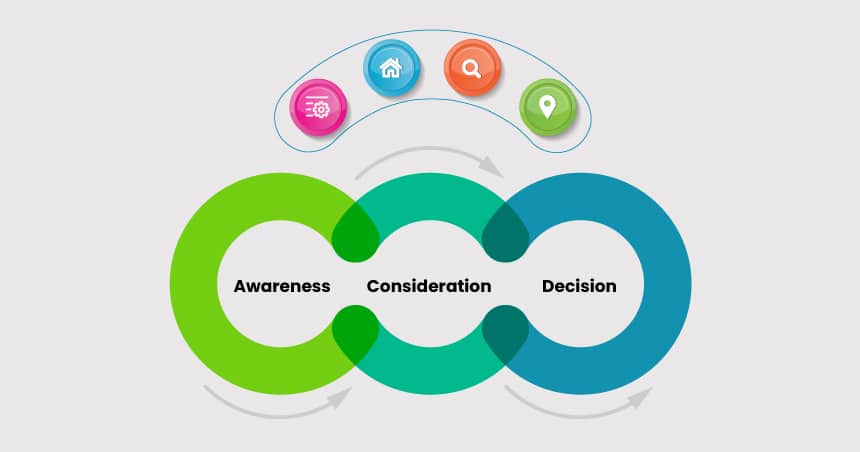
Most manufacturers still approach content marketing through a linear funnel: awareness, consideration, and decision. But in reality, industrial sales cycles are never linear. Buyers loop back, involve new stakeholders mid-cycle, and pause and restart over months or quarters.
Because of this, traditional funnel-based content strategies fall short; they don’t reflect how real manufacturing deals happen. It’s like casting a single fishing line into a sea full of species, all swimming at different depths. You miss most of the catch because you’re using the wrong bait, at the wrong depth, for the wrong fish.
What’s needed is an account-based content approach that addresses:
Think of modern B2B content like a high-tech fish finder—it’s not about casting wide but targeting precisely: knowing who the buyer is, where they are in the journey, and what will make them bite.
Every piece of content should be mapped to a specific stakeholder, tailored to their role, priorities, and stage in the cycle. That’s the essence of a strategic, account-based content approach.
This is where BattleBoard™ transforms theory into execution. It is a visual framework that maps a company’s positioning against competitors across key market dimensions, using color-coded insights to highlight strengths, gaps, and opportunities.
If you’re still guessing where your next lead will come from or relying solely on the sales team to “close the gap,” your marketing isn’t strategic. That’s where BattleBoard™ flips the script.
BattleBoard™ by ImpelHub is more than a benchmarking tool—it’s your dynamic command center for competitive strategy. While most manufacturers rely on fragmented data and one-size-fits-all go-to-market plans, BattleBoard™ delivers a real-time, 360° view of where your brand stands—and what it takes to move forward. Think of it like a sonar-guided fishing system: it doesn’t guess where the opportunity is; it pinpoints it.
Battleboard™ analyzes over 20+ industry-specific competitive dimensions to benchmark your brand against competitors, highlighting where you lead, lag, or have the potential to win. Each dimension is assigned a significance score based on the strength of your performance, supported by data and rationale, equipping your team with both the “why” and the “how.” Battleboard will also help manufacturers identify their top competitors and gain a deeper understanding of their customers.
Once your top competitors and key dimensions are mapped and your Ideal Customer Profiles (ICPs) graded, Battleboard™ generates tailored growth strategies specifically for the manufacturing sector.
Each strategy is evaluated using two key scores:
Both scores are calculated using business-relevant KPIs and then analyzed with statistical models (standard deviation and bell curve) to spotlight the top 16%—those most likely to deliver results. You can adjust the weight of each score based on your business priorities, ensuring the strategy mix aligns with your context.
After strategy selection, ImpelHub creates a custom growth playbook with a phased rollout plan. It accounts for operational realities such as production cycles, resource constraints, and the current growth phase, so strategies aren’t just theoretical but ready for execution on the factory floor and in the market.
This enables you not only to identify the next move but also to execute it with confidence and speed.
With BattleBoard™, teams can:
Manufacturers sit on a goldmine of operational data, most of which never reaches the marketing team. Disconnected CRM, ERP, and MES systems result in delayed insights and poorly timed messaging.
Integrating your Customer Relationship Management (CRM) system with your Enterprise Resource Planning (ERP) and Manufacturing Execution Systems (MES) creates a dynamic, responsive ecosystem where marketing can stop guessing and start acting on insights.
System | What It Tracks | How Marketing Can Use It |
CRM | Customer profiles, interactions, and sales pipeline | Personalize content and offers based on buyer journey and sales conversations |
ERP | Orders, inventory, fulfillment, reorders | Launch campaigns timed with order cycles, highlight cross-sell opportunities |
MES | Machine utilization, production schedules, and maintenance alerts | Trigger campaigns around maintenance or performance |
From personalized service reminders to dynamic upselling, integrated systems turn operational data into precision marketing.
Instead of relying on assumptions, manufacturers can use real-time production insights to fuel relevant and timely campaigns.
Production Insight | Marketing Application |
Customers nearing machine maintenance threshold | Proactive service campaign + upgrade bundle offers |
Underutilized product lines identified | Educational content campaign + discount reactivation offers |
High reorder frequency of certain SKUs | Loyalty-based upsell program with usage-based incentives |
Delayed production capacity flagged | Real-time updates + transparent messaging to retain trust |
This approach:

Buyers no longer want standalone parts—they want solutions that solve multiple pain points. Solution bundling transforms your offering from transactional to strategic. Through integrated product and service packages, you can create stronger value propositions that resonate deeply with target customers.
ImpelHub leverages its deep AI-driven competitor analysis and contextual insights to design tailored solution bundles that align with client needs and market gaps. Its approach to bundling is data-driven and deeply customized. By analyzing customer behavior, competitor offerings, and production capabilities, ImpelHub identifies ideal combinations of products and services that deliver maximum impact.
With ImpelHub, solution bundling evolves from a simple sales tactic into a strategic revenue growth engine designed specifically for the complexities and demands of the manufacturing sector.
In a manufacturing world flooded with generic marketing advice and disconnected tactics, ImpelHub offers clarity where others create noise. It’s not another agency offering cookie-cutter campaigns—it’s a strategic growth enabler. By combining human expertise with advanced AI tools, ImpelHub helps manufacturers move from scattered efforts to cohesive, ROI-focused strategies.
Most agencies approach manufacturing like any B2C brand—chasing vanity metrics and flashy ads. ImpelHub does the opposite. It starts with your business DNA: long sales cycles, technical buying committees, and operational complexities.
Here’s what sets it apart:
ImpelHub Approach | What Manufacturers Typically Face |
Context-Driven Intelligence: ImpelHub’s proprietary tools like BattleBoard™ and NextMove interpret data in your unique business’s context and industry dynamics. | Generic data dumps that fail to deliver actionable insights |
Dedicated Business Brain (LLM): Custom-trained AI brain aligned with your goals, products, and target accounts. | Off-the-shelf AI tools that don’t account for industry or organizational nuance. |
Human-AI Synergy (AILP): The AILP approach combines human strategic oversight with machine speed, delivering real-time decisions with strategic accuracy. | Fully automated tools with zero oversight or slow-moving consultants. |
BattleBoard™: Competitor mapping using 20+ similarity dimensions, identifying real market impact and counterstrategies. | Outdated SWOTs, manual research, and static reports. |
NextMove Growth Engine: Every strategy is scored for Impact and Innovation, prioritized using statistical modeling to focus only on the top 16% of high-return moves. | Broad, unprioritized recommendations with unclear ROI. |
While others cast a wide net and hope something sticks, ImpelHub brings laser focus. The difference? Strategic intelligence over shallow campaigns.
Manufacturers don’t need another generic playbook. They need context-rich insights and clear next steps. ImpelHub’s AI-powered tools like BattleBoard™, FoeScope AI, Insight360, and NextMove transform operational and market data into sharp, actionable strategies that attract, engage, and convert high-value buyers.
BattleBoard acts as your live command center, mapping competitors, customers, and market shifts across key strategic dimensions. It replaces speculation with real-time intelligence, revealing exactly why competitors win and how to outmaneuver them.
By replacing the “spray-and-pray” model with a scientific, insight-first strategy, ImpelHub transforms marketing into a predictable growth engine.
For most manufacturers, eCommerce is an afterthought—a web catalog or portal buried behind login walls, disconnected from marketing and sales.
But as buyer behavior evolves, this approach leads to:
Modern B2B buyers are doing 70% of their research online before ever speaking to sales. If your digital presence doesn’t serve as an active selling tool, you’re invisible.That’s why we partnered with Virtina—a leader in manufacturing eCommerce strategy.
Virtina specializes in building scalable, high-performing digital storefronts tailored to complex manufacturing workflows.
What Virtina Brings | How It Helps Manufacturers |
Platform-Agnostic Expertise: Virtina is certified across all major eCommerce platforms (Magento, Shopify, WooCommerce, and more). | Customizes the right solution without being locked into one tech stack. |
Custom B2B Functionality: Handles bulk pricing, quote workflows, ERP sync, and distributor portals. | Makes eCommerce scalable and relevant to how manufacturers actually sell. |
SEO & Speed Optimization: Builds lightning-fast, search-optimized websites. | Improves visibility, reduces bounce rate, and boosts conversions. |
Scalable B2C Sites: Enables direct-to-customer selling or new product line rollouts. | Unlocks additional revenue streams without disrupting core operations. |
Seamless Integration with ImpelHub’s Strategy | Marketing, product, and sales strategies are aligned to support eCommerce success from day one. |
By leveraging Virtina’s technical expertise and ImpelHub’s strategic insights, manufacturers can enhance their digital presence, unlock new revenue streams, and achieve sustainable growth.

Manufacturing marketing isn’t failing from lack of effort—it’s failing from lack of alignment. Most campaigns still rely on outdated tactics and generic messaging that miss the mark with today’s technical buyers.
Let’s recap:
Instead of chasing tactics, manufacturers need to build a strategy-first marketing engine—one that maps content to the buyer’s journey, aligns with sales, leverages real operational proof, and uses integrated data to stay relevant.
That’s what ImpelHub’s BattleBoard™ delivers. It doesn’t just tell you what to do—it shows you why, when, and for whom.
If you’re tired of vague campaigns and vanity metrics, it’s time to stop guessing.
Let’s talk.
Request a custom demo or book a strategic call to explore your growth plan. We’ll analyze your current marketing stack, identify untapped data and insights, and deliver a roadmap that actually drives ROI.
Final Thought:
You don’t need more noise—you need clarity. Clarity begins with strategy. And the right strategy transforms complexity into your competitive edge.
2 combos (1 competitor × 2 dimensions)
20 combos $5 per additional combo
100 combos $4 per additional combo
280 combos $3 per additional combo

7 Steps / 8 – 10 days / 2 – 3 hours of your time
Maximize your impact with ImpelHub’s Growth Lever Identifier—our AI-powered system that discovers your single biggest growth lever and accelerates your success. By analyzing your revenue streams, marketing channels, and core metrics, it highlights the most effective path to scalable growth and pinpoints your highest-ROI strategy, so you can focus on what truly matters, multiply your revenue, and stay ahead in today’s competitive market. Our clear, data-driven action plan ensures you can scale faster and more efficiently than ever.
Insight360, part of the “Your Business” pillar in the Business Brain/Context framework, delivers data-driven insights across 9 categories and 40+ business aspects, including market positioning, competition, revenue, trends, and brand identity.
It drives two key outputs:
With a multidimensional business view, Insight360 helps optimize positioning, enhance engagement, and accelerate growth.
Insight360+ expands on Insight360 with 15 additional dimensions, offering a deeper analysis of business strategy. It provides a self-reflective framework to uncover opportunities in:
With Insight360+, businesses refine strategies, strengthen positioning, and drive sustainable growth.
FanScope is a comprehensive catalog of buyer types, categorized by 10 key attributes, helping decision-makers assess and refine target audiences before segmentation.
As the first step in segmentation, FanScope informs:
By analyzing buyer roles, revenue segments, and purchase probabilities, FanScope enhances targeting, optimizes resources, and improves sales and marketing efficiency.
The Segmentation Module enhances customer targeting with Rated ICPs, Personas, and Firmographics (B2B), assessing each ICP across 22 attributes, including:
ICP Scoring evaluates profiles on 10 numerical dimensions, enabling businesses to prioritize high-value targets efficiently.
FoeScope is a competitive analysis framework that evaluates competitors across three revenue segments—small, medium, and large—relative to the business’s revenue. It assesses:
As a precursor to CounterEdge, FoeScope helps businesses identify and categorize key competitors, setting the stage for deeper competitive strategy development.
CounterEdge analyzes competitor growth strategies, their impact on the business, and countermeasures to stay competitive. It evaluates:
By leveraging CounterEdge, businesses can anticipate threats, mitigate risks, and implement winning strategies.
NextMove is a growth strategy framework that helps businesses identify, evaluate, and implement high-impact strategies. Each strategy is numerically rated across 10 dimensions, similar to ICP Rating, to prioritize the most effective paths for expansion.
With NextMove, businesses gain a data-driven approach to strategic growth, ensuring scalability, market expansion, and long-term success.
Launch-Execution Blueprint creates high-level execution plans for growth strategies, prioritizing them based on impact, feasibility, and business alignment.
By leveraging Launch-Execution Blueprint, businesses can streamline execution, focus on high-impact strategies, and drive measurable growth.
Maximize your impact with ImpelHub’s AI-powered Growth Lever Identifier. By analyzing revenue streams, marketing channels, and core metrics, it uncovers your biggest growth lever and highest-ROI strategy.
With a clear, data-driven action plan, you can focus on what matters, scale faster, and stay ahead in today’s competitive market.
Maximize your impact with ImpelHub’s Growth Lever Identifier—our AI-powered system that discovers your single biggest growth lever and accelerates your success. By analyzing your revenue streams, marketing channels, and core metrics, it highlights the most effective path to scalable growth and pinpoints your highest-ROI strategy, so you can focus on what truly matters, multiply your revenue, and stay ahead in today’s competitive market. Our clear, data-driven action plan ensures you can scale faster and more efficiently than ever.
Feature Gap Analysis is a powerful tool within ImpelHub that identifies missing or desired features based on the needs and expectations of the target audience. By leveraging Business Brain, it ensures that feature recommendations are strategically aligned with business goals and market demand.
Key Benefits:
Identifies Missing Features – Pinpoints gaps in the product or service offering.
Aligns with Target Audience Needs – Ensures features meet user expectations.
Prioritization via Impact Scoring – Helps decision-makers invest wisely.
Data-Driven Scoring Mechanism
Each feature is rated across five numerical dimensions, enabling businesses to prioritize development efforts effectively:
Revenue Boost
Cost Reduction
Customer Acquisition
Customer Retention
Customer Satisfaction
By leveraging Feature Gap Analysis, businesses can make informed investment decisions, enhance their product-market fit, and drive customer engagement and growth
UXI (User Experience Investigation) is a UI/UX audit framework that evaluates core business pages with unparalleled depth, powered by ImpelHub Audit. Unlike standard audits, ImpelHub leverages Business Brain, ensuring that recommendations are contextually aligned with the company’s strategy, market position, and growth objectives.
Key Audit Components:
Feature & Objective – Identifies key UI/UX elements and their purpose.
Details & Justification – Explains audit findings in a business-relevant manner.
Impact & Area – Evaluates influence on user experience.
Rationale – Context-driven reasoning for suggested improvements.
Impact-Driven Scoring Mechanism
Each UI/UX strategy is numerically rated across five dimensions, helping decision-makers prioritize investments:
Revenue Boost
Cost Reduction
Customer Acquisition
Customer Retention
Customer Satisfaction
This data-driven scoring allows businesses to allocate resources effectively, ensuring maximum ROI on UI/UX improvements and driving sustained growth
Detailed Execution Blueprint is a task list and project roadmap that breaks down high-level strategies into step-by-step, week-by-week execution plans, ready for team assignment and implementation.
Key Features:
Detailed Task Breakdown – Converts strategies into actionable steps.
Week-by-Week Execution Timeline – Ensures structured and phased implementation.
Team Assignments – Each plan is ready to be assigned to the relevant team for execution.
Operational Clarity & Accountability – Provides a clear roadmap to track progress.
By leveraging Launch-Detailed Plan, businesses can ensure smooth execution, improve efficiency, and drive successful implementation
FanScope is an extensive catalog of potential buyer types, both direct and indirect, categorized using 10 key attributes. It helps decision-makers identify, evaluate, and include or exclude buyer types before the segmentation process.
As the first step toward segmentation, FanScope informs:
ICP (Ideal Customer Profile) Definitions
Persona Development
Firmographics (B2B segmentation)
ICP Scoring
By analyzing buyer roles, revenue segments, pain points, and purchase probabilities, FanScope enables businesses to refine their target audience, optimize resource allocation, and improve sales and marketing efficiency.
The Segmentation Module refines customer targeting through Rated ICPs, Personas, and Firmographics (B2B). Each ICP is assessed across 22 attributes, covering:
Profile & Behavior – Segment, characteristics, decision-makers, and buying behavior.
Business Fit – Pain points, goals, product needs, and purchase drivers.
Engagement Factors – Technology, content consumption, marketing channels, and objections.
Strategic Insights – Value proposition, competition, and customer service needs.
ICP Scoring rates each profile on 10 numerical dimensions, helping decision-makers quickly prioritize the best targets for sales and marketing strategies
FoeScope is a competitive analysis framework that identifies and evaluates competitors across three revenue segments—small, medium, and large—relative to the business’s revenue. It assesses competitors based on:
Key Products/Services – Most similar offerings.
Geography – Market overlap.
Target Audience – Shared customer base.
Similarity Score & Reasoning – Measures alignment with the business.
FoeScope serves as a precursor to CounterEdge, laying the groundwork for deeper competitive strategy development by helping businesses identify and categorize their most relevant competitors
CounterEdge analyzes competitor growth strategies, their impact on the client’s business, and countermeasures to stay competitive. It evaluates:
Competitor Strength & Market Impact – Key advantages and threat level.
Affected Business Touchpoints – Areas influenced by competition.
Adaptation Strategy – Actionable countermeasures.
Impact Grade & Rationale – Severity of threat (1-5).
Potential Business Benefits – Strategic opportunities.
By leveraging CounterEdge, businesses can anticipate threats, mitigate risks, and implement winning strategies.
NextMove is a growth strategy framework designed to help businesses identify, evaluate, and implement high-impact strategies. Each strategy is numerically rated across 10 dimensions, similar to ICP Rating, allowing decision-makers to prioritize the most effective paths for expansion.
Key Assessment Areas:
Strategy Type, Objective & Target Audience – Defines the approach, aligns with Ideal Customer Profiles (ICPs), and ensures relevance to market needs.
Key Tactics & Content Marketing – Outlines the execution plan, including marketing initiatives to drive engagement.
Required Resources & Risk Assessment – Identifies necessary investments, potential risks, and feasibility.
Timeline & Measurement Metrics – Provides a structured roadmap for execution and tracking success.
Relevance (%) & Potential Impact – Scores strategies based on alignment with business goals, market trends, and competitive landscape.
By leveraging NextMove, businesses gain a data-driven approach to strategic growth, enabling them to quickly assess and implement the most effective strategies for scalability, market expansion, and long-term success.
GTM/Scale Up Playbook creates high-level execution plans for selected growth strategies, ensuring effective implementation. It prioritizes strategies based on impact, feasibility, and alignment with business objectives.
Key Components:
Phases – Defines the execution stage.
Strategy Score – Numerical rating for prioritization.
Strategy Suggestions & Rationale – Recommended actions with justification.
Highlights – Key takeaways and strategic advantages.
Related Strategy – Links to complementary approaches.
Targeted ICPs (ICP Phase) – Aligns execution with the right customer segments.
By leveraging GTM/Scale Up Playbook, businesses can streamline execution, focus on high-impact strategies, and drive measurable growth.
Insight360 is a key component of the “Your Business” pillar within the Business Brain/Context framework. It delivers data-driven insights across 9 key categories, covering 40+ critical business aspects, including market positioning, competitive landscape, revenue analysis, industry trends, and brand identity.
These insights drive two strategic outputs:
Custom Growth Strategies – Tailored plans developed with AI, Impelian, Impelist, and human expertise to support business expansion and address key challenges.
Contextual UI/UX Audit – Identifies feature gaps and aligns product offerings with market needs.
Insight360 provides a multidimensional understanding of the business, industry, and competitive landscape. By leveraging these insights, businesses can optimize market positioning, enhance customer engagement, and accelerate growth.
Insight360+ enhances Insight360 by analyzing a business at a deeper level through 15 additional dimensions. It provides a self-reflective framework to uncover strategic opportunities in:
Sales & Revenue Optimization – Pricing models, sales processes, and client strategies.
Market & Digital Presence – Online marketing, industry positioning, and partnerships.
Innovation & Technology – AI /Tech integration and product/service development.
With Insight360+, businesses gain a more comprehensive perspective to refine strategies, strengthen market positioning, and drive sustainable growth.

Founder & CEO

Co-Founder & Chief Revenue Officer
Please enter your email to download the Sample Score Card.
Please enter your email to download the playbook.
Unlock exclusive tools for growth